Me: It's time for you to go back in the field now, Chloe.
Chloe: What bizarre ideas you do have.
Me: No, really, it's time to go back in.
Chloe: Nonsense, I don't live in the field, I live on the lawn.
Me: Chloe, come on, it's time to go.
Chloe: It is fruitless for you to insist, I have made up my mind.
Me: Ok, how about we play the game "Moving Your Feet"?
Chloe: All right, you start.
Me: How about you move your back legs thataway?
Chloe: All rightie.
Me: How about moving them the other way?
Chloe: Very well.
Me: Let's try that again, shall we?
Chloe: Don't push your luck. Once each direction is enough.
Me: Ok, how about you move your front legs thataway?
Chloe: Ok.
Me: How about the other way?
Chloe: Sure, why not.
Me: And again?
Chloe: I thought we discussed this already.
Me: Oh, all right. How about you take a step backward?
Chloe: Fine.
Me: And ... how about forward?
Chloe: Do you think I'm stupid? I know this is a ruse to get me to go back into the field.
Me: Ok, how about I sit down here on the ground beside you?
Chloe: Excellent idea. [chews] As a matter of fact, this would be a good time to take a little nap.
Long interval during which June becomes bored.
Me: All right. I'm going to feed the OTHERS. In the FIELD.
Chloe: Hey, give me that bucket.
Me: Nuh uh, not til you get back in the field. Look at George eating his yummy dinner, and Bridget and Rose, and here's yours - look I'm putting it down on the other side of the fence.
Chloe: There must be some mistake. I'm supposed to be served dinner on the LAWN. Goodness me. Where is it? I can't find it.
Me: Chloe, you are making me CRAZY. I'm putting this rope around your neck, and I'm going to stand here until you follow me. I am not even kidding.
Chloe: I am a lawn-dweller. I do not speak your language.
Me: CHLOE!
Chloe: Oh whatever, I'm coming, where did you put that food again?
Wednesday, August 18, 2010


Sunday, August 15, 2010
What Not to Wear While Riding

My daughter and Rose were out grazing the lawn. My daughter is going back to college in a couple of days, and she remarked wistfully that she hadn't had a chance to ride Rose this summer, as Rose "wasn't ready." She's been popping into the field over the summer to visit Rose, so I said, "Why don't you ask her if she minds if you hop up?" So she put her hands on Rose's back and jumped up and down a couple of times. Rose continued placidly grazing.
So then I bent one knee to make a mounting block, and my daughter climbed onto Rose's back. Rose remained unperturbed.


Very different from last time we tried this.
George was out with my youngest daughter today. She is much stricter with him than I am. She is very strict with me too. My oldest daughter says we ought to get Super Nanny in to get her back under control. However, I have vetoed this, as for sure she and Super Nanny would gang up together and try to get me under control. Anyway, she insists on George behaving. This, on the other hand, is how George is with me these days:
"WOMAN! Open this gate! WOMAN! What do you mean I can't go over there? WOMAN! I'm bored! Come get me! WOMAN! Bring me treats! Now! WOMAN! Get over here and pay attention to ME! NOW!"
So, yeah.
Here is Rose making a funny face while chewing an apple -

Thursday, August 12, 2010
Transition
Anyone who has been through labor knows there is a particularly grueling stage of that delightful process known as "transition." Transition is the last stage of labor before pushing starts and is characterized by a desire to just call the whole thing off. They tell you in childbirth class that when you get the feeling you can't stand it a minute longer, that's when you know you're nearly there. I remember actually calling this to mind when I was having my first child. I remember thinking, "This really sucks. Oh good, that must mean we're getting close."
With the horses, I've found that whenever I become frustrated or discouraged, a transition of some kind is usually just around the corner.
Today I was just feeling a bit grouchy about the whole thing. I was just getting a bit sick of Bridget turning me into a non-stop butt-scratching machine and wondering if we were ever going to move forward. But in the midst of my Grinch mood, I did remind myself that this frustration was probably not such a bad sign.
This evening I went to get George out of the field to take him for a grazing walk, because he was so sad and jealous earlier when Chloe got to come out and eat the lawn. We went on a large, leisurely loop, passing [yhhhhu7yrfu34 - I left this in, because it was made by kitten feet] many juicy green plants for the eating of. After I'd returned George to his field, we hung out. He wanted me to stand by his tail and scratch him. Every now and then I'd move, but he'd always return me to the same spot. After quite a long time (with what I'd have to call a flourish), he spun around, plonked me into a spot touching his neck, and stood still. I suddenly felt very warm towards him. And then he Chewed.
The blog, Ponies at Home, talks a lot about The Chew. It's from Jenny Pearce's book Zen Connection with Horses. Here's how Pearce describes it:
When I embarked on this journey with George, I had no idea it would be so long. When I first took him out of his pasture after reading Empowered Horses and said, "Buddy," (because that was his name back then) "you get to decide now," I had no idea that over a year later we would only just be taking the first, tentative steps toward mutual understanding.
After George and I had stood for a while, he turned his head toward the other horses, who had drifted away from us. I asked him if he wanted to go and join them, and we started walking in their direction. After a few steps, I stopped, intending to leave, assuming he would continue on his own. But after a couple more steps he stopped too, with his back to me, and waited until I started walking again. We joined the others. Bridget came over to me, but George gave her The Look, and she left. I stayed with George a little longer, said goodnight, swung by Chloe to say goodnight, and headed back to the house.
Here are Bridget and Chloe and Rose coming over to check me out sitting in the lawn chair again earlier this evening. I only sat for a minute, because the wee tear in the seat which George made with his teeth yesterday quickly grew into a gaping hole when I sat my dainty self down.

With the horses, I've found that whenever I become frustrated or discouraged, a transition of some kind is usually just around the corner.
Today I was just feeling a bit grouchy about the whole thing. I was just getting a bit sick of Bridget turning me into a non-stop butt-scratching machine and wondering if we were ever going to move forward. But in the midst of my Grinch mood, I did remind myself that this frustration was probably not such a bad sign.
This evening I went to get George out of the field to take him for a grazing walk, because he was so sad and jealous earlier when Chloe got to come out and eat the lawn. We went on a large, leisurely loop, passing [yhhhhu7yrfu34 - I left this in, because it was made by kitten feet] many juicy green plants for the eating of. After I'd returned George to his field, we hung out. He wanted me to stand by his tail and scratch him. Every now and then I'd move, but he'd always return me to the same spot. After quite a long time (with what I'd have to call a flourish), he spun around, plonked me into a spot touching his neck, and stood still. I suddenly felt very warm towards him. And then he Chewed.
The blog, Ponies at Home, talks a lot about The Chew. It's from Jenny Pearce's book Zen Connection with Horses. Here's how Pearce describes it:
They give us The Chew when they understand us - they give us The Chew when we understand them. .... It's a physical signal of understood communication.I can't recall George ever chewing before, not without food in his mouth that is. I've read about The Chew, and "waiting for The Chew," but this was the first time I've consciously experienced it. In the last couple of days, I've been becoming more and more aware of George's need for intimacy and unconditional acceptance. I guess, I hope, that the rush of warmth I felt was a shared warmth and that his Chew was an acknowledgment of that.
When I embarked on this journey with George, I had no idea it would be so long. When I first took him out of his pasture after reading Empowered Horses and said, "Buddy," (because that was his name back then) "you get to decide now," I had no idea that over a year later we would only just be taking the first, tentative steps toward mutual understanding.
After George and I had stood for a while, he turned his head toward the other horses, who had drifted away from us. I asked him if he wanted to go and join them, and we started walking in their direction. After a few steps, I stopped, intending to leave, assuming he would continue on his own. But after a couple more steps he stopped too, with his back to me, and waited until I started walking again. We joined the others. Bridget came over to me, but George gave her The Look, and she left. I stayed with George a little longer, said goodnight, swung by Chloe to say goodnight, and headed back to the house.
Here are Bridget and Chloe and Rose coming over to check me out sitting in the lawn chair again earlier this evening. I only sat for a minute, because the wee tear in the seat which George made with his teeth yesterday quickly grew into a gaping hole when I sat my dainty self down.

In the Hot Seat
Yesterday, feeling rather sleepy, I took a folding lawn chair into the horses' field, plonked it down, and sat in it to admire the view.
Before long, George came over to see what was up. He chewed the chair a bit, and was all for chewing my knees, which were much more accessible than usual, as well as my hair, which ditto. He and Bridget took turns examining the strange phenomenon of a seated June, Bridget circling back as soon as George left, and leaving again when he returned.
I felt quite vulnerable sitting so low compared to the horses, especially when they started pawing me. (Yes, even George thought he'd give that a try.) But I also noticed that, for me as a human, sitting is more relaxed. I felt a little like I'd brought a piece of my human world into the field - Here's what we humans do, we sit, and we just kindof chill.
After he was done trying to munch various parts of me and my chair, George spent some time standing next to my chair in a companionable kind of way. Bridget, however, was much too curious to settle down. At one point, when both George and Bridget had finally wandered off, Chloe saw her chance to come over. I was looking forward to some quiet Chloe time - she would not try to chew on me - but George soon returned.
I gave George and Bridget each a chance to inspect the chair without me on it. George wanted to pick it up in his teeth and shake it. Bridget wanted to paw it.
Speaking of Bridget pawing - I don't know what originated the practice - but we've got a little routine going now. She reaches out a leg; I catch it and stretch it towards me. She seems to like this and sometimes gives a little groan or grunt. She'll often end up opening her mouth and stretching her jaw wide.
Chloe is getting good at getting in and out of the field without clashing with George. Today, I caught her looking at me meaningfully. We sneaked down the fence to the gate, and she got through smartly before George noticed. When it was time to go back in, she waited outside the gate while I fiddled about, making the others back off. As soon as the gate was open and the coast was clear, she quick dashed through. Poor George was quite put out that she had a chance to go out and eat more grass than him. Last night, and again today, we finally got some good rain. You can already see the new green shoots of grass.
Sunday, August 8, 2010
Follow the Leader, etc.
I think maybe a more descriptive term than "passive leader" would be "followee."
The passive leader horse doesn't actually intend to lead his or her fellow horses; at least that's the impression I get from reading Rashid. It's more a case of the leader horse going about its business, with the other horses tagging along.
So when a horse follows a human, the human can emulate the leader horse and just be like "Hey, you're following me, that's cool, I'm over here eating grass, it's fine if you join me." Or I suppose the human could start making suggestions for the horse to follow. And because the horse is in following mode, it might go along.
KFH doesn't leave it to chance. In Dancing with Horses, he describes how to lead a horse. (p.78) Now it's a known fact that one whiff of Klaus's Celtic soul is enough to make all horses instantly follow him. However, for mere mortals he has a trick to help you get started: you have a helper walk behind the horse, carrying a whip.
The condition I'm in at the moment is that the horses will follow me some of the time, but not all of the time, when we're in the field. If we're out on a leadrope, I can always cajole them into following me, even if they're not immediately inclined to do so. I usually do this by turning my back to them and sending strong thought waves down the leadrope, saying "Come on."
(These comments do not apply to Chloe, who never follows me in the field, even though she often wants to spend time with me there, and who has to be 500% convinced when out on the leadrope that there's no way she can dissuade me from putting her back in the pasture.)
Today, Rose followed me for the first time. I was hanging out with the horses and moved up the field to another spot. To my surprise, the first one to follow me was Rose. Bridget often follows me. But the one who follows me the most is George. Who is the alpha horse and the one whom the others don't like to follow.
So far I don't "do" anything much with the followeeship bestowed on me. But there's a certain level of trust that I guess we could work with, which might lead to something sometime. You never know.
On the subject of not-letting-the-horse-move-your-feet, a taboo which I now officially spurn - Bridget often bumps into me to get me to scratch her butt. It feels rather too intrusive, so I move away from the bump and then reach over and gently touch her hip and ask her to move toward me again, but more softly this time. Whereupon she moves over more slowly, without bumping.
George, I feel, is kind of lonely sometimes. So I always pay attention to him first, if he wants, and wait until he's ready to let me talk to the others. I feel that driving him away and being tough on him, as he's been treated in the past, isolates him emotionally. He often wants to tuck me into his side. He's taken to placing me by his tail also. At first I thought he wanted me to scratch him, like Bridget - but I feel perhaps he just likes to have me stand there.
Here's where he usually likes to put me:


I thought Chloe was having a hard time getting up after rolling, but she was rubbing her tummy back and forth on the scratchy grass:

The passive leader horse doesn't actually intend to lead his or her fellow horses; at least that's the impression I get from reading Rashid. It's more a case of the leader horse going about its business, with the other horses tagging along.
So when a horse follows a human, the human can emulate the leader horse and just be like "Hey, you're following me, that's cool, I'm over here eating grass, it's fine if you join me." Or I suppose the human could start making suggestions for the horse to follow. And because the horse is in following mode, it might go along.
KFH doesn't leave it to chance. In Dancing with Horses, he describes how to lead a horse. (p.78) Now it's a known fact that one whiff of Klaus's Celtic soul is enough to make all horses instantly follow him. However, for mere mortals he has a trick to help you get started: you have a helper walk behind the horse, carrying a whip.
The condition I'm in at the moment is that the horses will follow me some of the time, but not all of the time, when we're in the field. If we're out on a leadrope, I can always cajole them into following me, even if they're not immediately inclined to do so. I usually do this by turning my back to them and sending strong thought waves down the leadrope, saying "Come on."
(These comments do not apply to Chloe, who never follows me in the field, even though she often wants to spend time with me there, and who has to be 500% convinced when out on the leadrope that there's no way she can dissuade me from putting her back in the pasture.)
Today, Rose followed me for the first time. I was hanging out with the horses and moved up the field to another spot. To my surprise, the first one to follow me was Rose. Bridget often follows me. But the one who follows me the most is George. Who is the alpha horse and the one whom the others don't like to follow.
So far I don't "do" anything much with the followeeship bestowed on me. But there's a certain level of trust that I guess we could work with, which might lead to something sometime. You never know.
On the subject of not-letting-the-horse-move-your-feet, a taboo which I now officially spurn - Bridget often bumps into me to get me to scratch her butt. It feels rather too intrusive, so I move away from the bump and then reach over and gently touch her hip and ask her to move toward me again, but more softly this time. Whereupon she moves over more slowly, without bumping.
George, I feel, is kind of lonely sometimes. So I always pay attention to him first, if he wants, and wait until he's ready to let me talk to the others. I feel that driving him away and being tough on him, as he's been treated in the past, isolates him emotionally. He often wants to tuck me into his side. He's taken to placing me by his tail also. At first I thought he wanted me to scratch him, like Bridget - but I feel perhaps he just likes to have me stand there.
Here's where he usually likes to put me:


but sometimes he puts me here:

Here he is nudging aside my be-wellingtoned leg so he can get at the grass underneath:

I thought Chloe was having a hard time getting up after rolling, but she was rubbing her tummy back and forth on the scratchy grass:

See the drought we're having?
Saturday, August 7, 2010
Connecting with Horses; Horses Never Lie; Zen Connection with Horses
These three books, which I have read in rapid succession (and partially on the beach), are getting dangerously jumbled up in my head. However, they share certain important things in common. Which gives me the confidence, once and for all, to reaffirm (sing with me, Jen-ska): "Dominance shmominance!"
The flip side of dominance, of course, is submission, and something from Connecting with Horses really says it all: "A horse that is submissive due to being fearful or dominated is not the same as a trusting horse." (p.62, emphasis mine)
Zen Connection with Horses makes a distinction between dominance and leadership. Pearce points out that "horses don't co-operate willingly with the dominant horse" (p.88) whereas a horse "just simply does what the leader wants, smoothly and easily." (p.89) She describes leadership as the ability to control speed and direction without force (p. 90) and also lists 22 ways to "give leadership away."(pp. 93-96) However, she believes that it is not necessary even to be the horse's leader; if you have trust and co-operation, that can be enough. She describes a boy, Asbrandt, and his horse, Harry:
Mark Rashid's book Horses Never Lie specifically deals with the difference between the alpha horse and the passive leader horse (called "passive" because he does not seize power on his own initiative but is appointed). The alpha horse is always causing a commotion, driving his subordinates around, and making them anxious. The passive leader, on the other hand, is a quiet, consistent horse, who is both tolerant and confident. The most telling story Rashid relates, I think, is about a horse called Buck. (pp. 58-62) Buck, on being introduced into a new herd, was unfazed by the dominant horse's aggression and gradually wore him down until he let Buck join him at the feeder. Buck himself, however, never ran another horse off.
The way Buck wore down a dominant horse - and this ties into something I'm sure many of us have been warned about - was not by refusing to let the dominant horse move his feet. When the aggressive alpha charged at him, he would move away - but only as far as necessary to keep out of harm - and then he'd proceed to move forward again. He did not react with anger or fear but with patience and persistence. On one occasion, an aggressive alpha mare ended up following him around like a puppy.
Margrit Coates, in Connecting with Horses, is willing to step forward and make some very radical and poetic statements: "Horses are willing to trust when offered unconditional love. Then the heart of the horse will be light." (p.62) This, of course, is no particular help at all to someone looking for concrete advice, but Mark Rashid, in his more down-home cowboy tone says something similar when he declares,
It's not that Coates, Pearce and Rashid don't train their horses. They do. And - especially in Rashid's case, it seems - their horses follow more or less conventional lifestyles. But I think the thing is that they don't start with training. They start with relationship.
The most challenging thing for me to think about after reading these books is Coates' and Pearce's belief in inter-species communication - not just the ability to trust and cooperate with each other, but the ability of the horse to communicate (by images, words, or ideas) specific information directly to the human's mind, such as past events in the horse's life, or suggestions for the horse's training. To be honest, I've always thought of "animal communicators" as a bit on the flaky side. However, while I remain dubious, I've decided to open my mind to the idea. We'll see.
So - here's what I've learned:
It's ok if your horse moves your feet.
It's true - you really don't have to dominate your horse.
You can try to be a leader, but don't worry if you can't.
Never get mad.
There's other cool stuff too - such as Pearce's "Chew". But those are the important things for me.
I think next stop on the Book Train has to be something by Resnick. Any suggestions?
The flip side of dominance, of course, is submission, and something from Connecting with Horses really says it all: "A horse that is submissive due to being fearful or dominated is not the same as a trusting horse." (p.62, emphasis mine)
Zen Connection with Horses makes a distinction between dominance and leadership. Pearce points out that "horses don't co-operate willingly with the dominant horse" (p.88) whereas a horse "just simply does what the leader wants, smoothly and easily." (p.89) She describes leadership as the ability to control speed and direction without force (p. 90) and also lists 22 ways to "give leadership away."(pp. 93-96) However, she believes that it is not necessary even to be the horse's leader; if you have trust and co-operation, that can be enough. She describes a boy, Asbrandt, and his horse, Harry:
Eventually there will be much more stuff that they do together that Asbrandt will be the leader in, with Harry still the leader in other areas. Sometimes they'll even swap leadership, without need for argument, just because that's what the day brings them.
If Asbrandt gets to be a truly brilliant horseman, if that is his dream, he may become Harry's leader in everything that they do together. BUT THAT MAY NEVER HAPPEN. So who cares? If he reaches his dream, whatever that is and he's safe and enjoying himself, who cares if he's not the leader?I feel that although KFH talks a lot about dominance and submission, he is actually demonstrating leadership. However, most of us (especially me) are simply not up to being the leader the whole time. Pearce's comments about Asbrandt and Harry are a reassuring reminder that most leaders are not made overnight but must gradually learn the necessary skills and confidence. We're not in the army here, and it's ok to take turns being the leader. It won't lead to our horse taking advantage of us.
Mark Rashid's book Horses Never Lie specifically deals with the difference between the alpha horse and the passive leader horse (called "passive" because he does not seize power on his own initiative but is appointed). The alpha horse is always causing a commotion, driving his subordinates around, and making them anxious. The passive leader, on the other hand, is a quiet, consistent horse, who is both tolerant and confident. The most telling story Rashid relates, I think, is about a horse called Buck. (pp. 58-62) Buck, on being introduced into a new herd, was unfazed by the dominant horse's aggression and gradually wore him down until he let Buck join him at the feeder. Buck himself, however, never ran another horse off.
The way Buck wore down a dominant horse - and this ties into something I'm sure many of us have been warned about - was not by refusing to let the dominant horse move his feet. When the aggressive alpha charged at him, he would move away - but only as far as necessary to keep out of harm - and then he'd proceed to move forward again. He did not react with anger or fear but with patience and persistence. On one occasion, an aggressive alpha mare ended up following him around like a puppy.
Margrit Coates, in Connecting with Horses, is willing to step forward and make some very radical and poetic statements: "Horses are willing to trust when offered unconditional love. Then the heart of the horse will be light." (p.62) This, of course, is no particular help at all to someone looking for concrete advice, but Mark Rashid, in his more down-home cowboy tone says something similar when he declares,
[O]ne of the most important parts of horse training really has nothing to do with training at all. It has to do with being able to look at, and understand, the possibility that our horses just may have a different perspective on life than we do. (p. 81)Margrit Coates reports one of her students saying, "Being with the horse is about creating a feeling space, not a thinking space." (p. 69) I think this is key, if we are following a way which has "nothing to do with training at all" and which involves throwing away the desire to dominate the horse. There is no road map - which is what we've all been discovering.
It's not that Coates, Pearce and Rashid don't train their horses. They do. And - especially in Rashid's case, it seems - their horses follow more or less conventional lifestyles. But I think the thing is that they don't start with training. They start with relationship.
The most challenging thing for me to think about after reading these books is Coates' and Pearce's belief in inter-species communication - not just the ability to trust and cooperate with each other, but the ability of the horse to communicate (by images, words, or ideas) specific information directly to the human's mind, such as past events in the horse's life, or suggestions for the horse's training. To be honest, I've always thought of "animal communicators" as a bit on the flaky side. However, while I remain dubious, I've decided to open my mind to the idea. We'll see.
So - here's what I've learned:
It's ok if your horse moves your feet.
It's true - you really don't have to dominate your horse.
You can try to be a leader, but don't worry if you can't.
Never get mad.
There's other cool stuff too - such as Pearce's "Chew". But those are the important things for me.
I think next stop on the Book Train has to be something by Resnick. Any suggestions?
Thursday, August 5, 2010
Out and About
When Bridget comes out of the pasture, she often goes on a quest to sample different plants, such as wisteria:




Before she'd eaten very much, I told her we'd better check with Mr. Google to see if it's poisonous. Which it is. I called the vet, who wasn't particularly concerned, and Bridget was fine. I wonder if there's something in wisteria which might help her leg wound? Mr. Google couldn't help me there.
Here she is enjoying the leaves of a tree. It looks harmless, so I've been letting her tuck in:

Sometimes she just eats grass:

She tried to eat this tablecloth - I just missed catching the moment on camera:

She had a nibble of the bicycle:

When George goes out for an expedition, he's more interested in inspecting the property. Here he's checking out what's on the other side of this fence:

He seems to think the compost bin smells bad (funny, I didn't notice that expression until I looked at the photo):

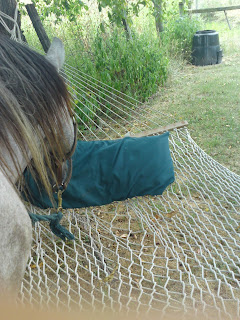
The hammock is sort of interesting:


The porch is positively fascinating:


We definitely have to find out what goes on up there:


Here's Rose out for an amble with my daughter:

When Chloe goes out, she likes to graze the lawn while I sit in the hammock. There's probably a gin and tonic in my other hand.

Subscribe to:
Posts (Atom)